Most Profitable Niches for AI Videos in 2026
The most profitable YouTube niches for AI video channels in 2026 — verified RPM ranges from creator dashboards, real channel examples, and the niches that survived the July 2025 inauthentic-content policy.
Most Profitable Niches for AI Videos in 2026
Every "top 10 niches" post you've read mixes up two numbers and skips a third.
The two it confuses are CPM and RPM. CPM is what advertisers pay YouTube. RPM is what you keep after YouTube's 45% cut and ad-blocker losses. A "$22 CPM finance niche" usually delivers about $10–15 RPM in your dashboard — which is still great, but not the number on the listicle.
The third number it skips is the one that decides whether your channel makes money or sits at 47 subscribers for nine months. We'll get to that.
This post is built from verified data, not guru spreadsheets. RPM figures come from creator-dashboard data published by OutlierKit (March 2026) and the highest-paying niches breakdown (Jan 2026), cross-checked against the LearningRevolution earnings calculator (March 2026) and creator self-reports on r/PartneredYoutube. Channel examples are real channels you can search and watch tonight. Sources are listed at the bottom.
If you came here expecting "make finance videos, finance pays $30 RPM, you're rich" — close the tab. The real numbers are tighter, the competition is harder, and the niches that actually print money in 2026 aren't the ones at the top of the listicle.
CPM vs RPM: the distinction that costs creators money
Before any of the rankings, this:
- CPM = what an advertiser pays YouTube per 1,000 ad impressions
- RPM = what you receive per 1,000 video views, after YouTube's 45% share, ad-blocker viewers, and non-monetized views
Per OutlierKit's March 2026 dashboard data, a $15 CPM typically translates to about $8 RPM in a real creator's account. That ratio holds across most niches.
Every number in this post is RPM — the dollar that lands in your bank — not the inflated CPM number gurus quote to make their thumbnails work.
Country also matters. DigitalInformationWorld (Aug 2025) reports US average CPM at $11.95, Pakistan at $0.42 — a 28x gap. AWisee (July 2025) puts the US at $32.75 for top categories and Australia at $36.21. The same finance script earns 10–15x more from a US viewer than an Indian one. Most of the RPM ranges below assume a US-skewed audience.
The profitability formula nobody publishes
Most posts use this implicit formula:
Profitability = RPM
This is wrong. Here's what actually matters:
Profitability = RPM × Search Volume × AI-execution Fit × (1 / Competition)
Four variables. Skip any one and the math collapses.
RPM is what YouTube actually pays you. Verified ranges below.
Search volume is whether anybody is looking. A $40 RPM niche with 200 monthly searches is a worse business than a $4 RPM niche with 200,000 searches. Math: 200 × $40 = $8,000 ceiling. 200,000 × $4 = $800,000 ceiling. Volume wins by two orders of magnitude.
AI-execution fit is how cleanly your niche works without a face on camera, without live footage, and within current AI voice and visual limits. A meditation channel scores 10. A reaction channel scores 1. A finance explainer scores 8. A travel vlog scores 2.
Competition is the saturation tax. OutlierKit's March 2026 data tracks niche size by active-channel count. "Personal finance" sits in the high-competition bucket. "Senior health and longevity" has roughly 10,000 channels — about 5–10% of finance — with a 19x growth multiplier in viewership year-over-year. That's the third number guides skip.
The Profitability Score (PS) framework
| Variable | Range | Weight |
|---|---|---|
| RPM | 1–10 | 25% |
| Search volume | 1–10 | 30% |
| AI-execution fit | 1–10 | 25% |
| Competition (inverted) | 1–10 | 20% |
Now the niches. Every RPM number below is verified RPM — sourced and dated, not rounded up from an advertiser-friendly CPM.
YouTube RPM by Niche: The Real Numbers
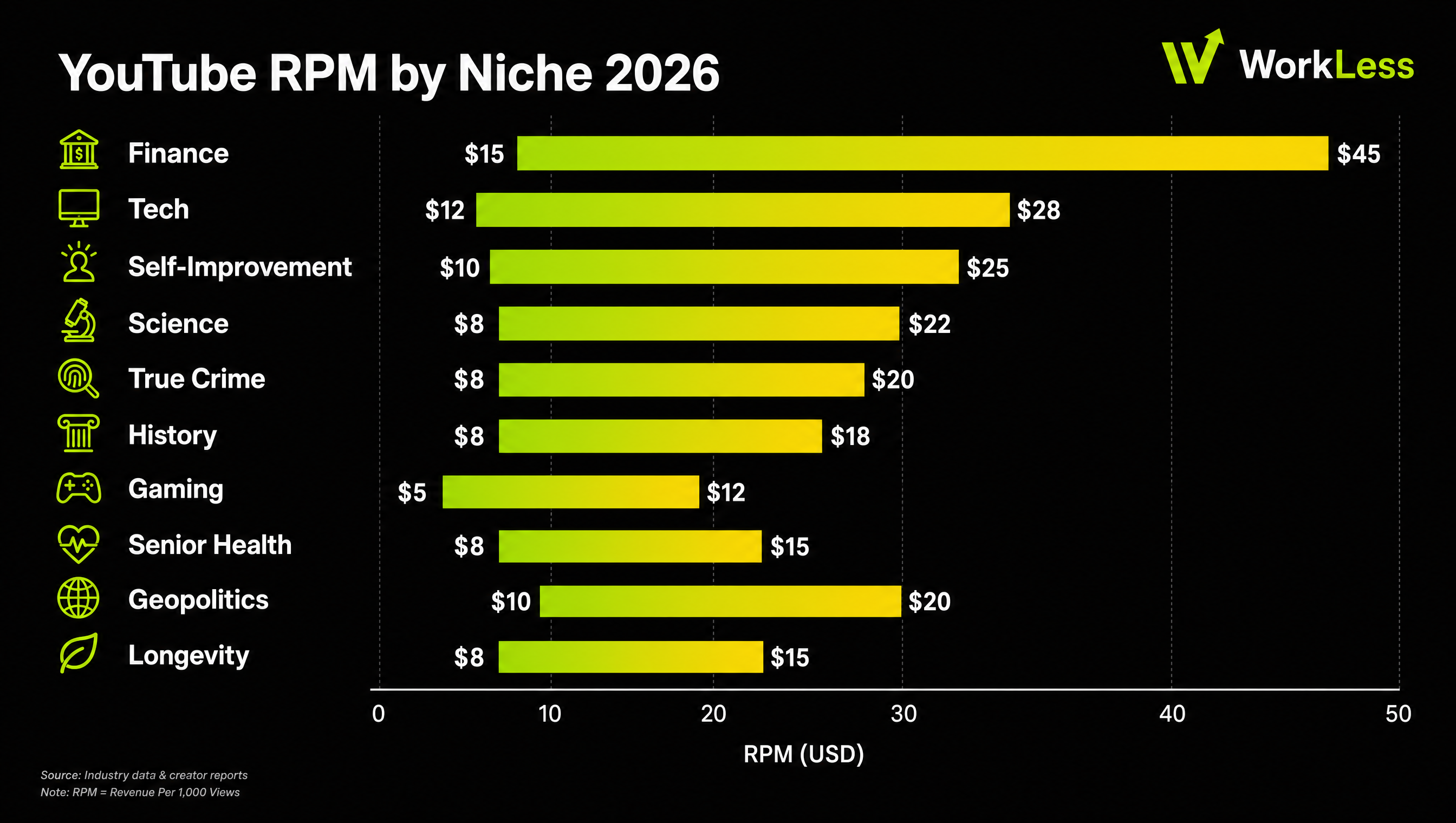
RPM ranges verified from OutlierKit creator dashboard data (March 2026). Chart shows minimum-to-maximum earning potential per 1,000 views.
Top 10 most profitable AI video niches in 2026 (verified data)
1. Personal finance — narrow segments
- Verified RPM range: $10–15 (CPM $15–22)
- Source: OutlierKit highest-paying niches, Jan 2026; TastyEdits Jan 2026 lists $12 CPM average
- AI-execution fit: 8/10
- Competition: High at the head, soft at the long-tail
- PS Score: 8.4/10
The classic gold standard. Verified ceiling — not the $30+ RPM you see on listicle thumbnails. The top-decile finance creator in OutlierKit's dataset hits $20+ RPM, and that's after years of audience-trust compounding.
Real channel example: Graham Stephan — ~5M subscribers, estimated $163,000/month from YouTube AdSense alone, RPM in the $16–$20 range per industry research cited by Upgrowth (April 2026). His content focuses on credit cards, investing, and real estate — the highest-CPM finance sub-niches.
The "personal finance for beginners" lane closed in 2018 and got smashed harder in 2022. What's not closed: vertical-specific finance. Tax basics for OnlyFans creators. Investing for engineers in their 30s. Freelancer retirement accounts. Personal finance for nurses. Same RPM tier ($10–14), search volume in the hundreds-to-low-thousands per topic but compounding, and competition you can actually beat.
The catch: YouTube's July 15, 2025 YPP "inauthentic content" policy update explicitly targeted mass-produced and repetitious content. Templated finance videos with light variation now get throttled. Stick to systems and frameworks. Specific stock picks, "guaranteed returns," and crypto recommendations remain demonetization bait.
2. History narrative explainers
- Verified RPM range: $4–9 traditional educational; up to $11 for sleep-format documentaries
- Source: OutlierKit March 2026 dashboard ($10.92 RPM for "soundscapes for sleep/healing" — long-form history narration sits in the same bucket); educational explainer baseline $5–9
- AI-execution fit: 9/10
- Competition: Medium
- PS Score: 8.1/10
The most underrated AI video niche, and there's now a documented playbook for it.
Real channel example: Boring History (@BoringHistoryofficial) — built by Adavia Davis, a 22-year-old Mississippi State dropout. The channel runs six-hour "history to sleep to" documentaries narrated by an ElevenLabs voice tuned to sound like a languid David Attenborough. Fortune (Dec 30, 2025) reviewed Davis's AdSense payouts: his network of channels — most with 400K to 1M+ subscribers — generates $40,000–$60,000/month ($700K/year) at 85–89% margins, with cost per video around $60 (Claude scripts + ElevenLabs narration + a custom pipeline called TubeGen). His network averages 2M views/day.
Real channel example (premium tier): Kurzgesagt – In a Nutshell — 24M+ subscribers as of Wikipedia, Nov 2025, 310+ videos, the world's 265th most-subscribed channel. Animated faceless format, science/history hybrid. Production cost is wildly higher than Boring History — but proves the upper bound of the niche.
Real channel example (mid-tier): OverSimplified — 8M+ subscribers, faceless animated history, per Invideo's faceless channels list (Feb 2025).
The catch: YouTube's July 2025 update specifically named "mass-produced" content. Boring History–style six-hour AI documentaries are surviving because retention is high (people sleep through them — the algorithm reads that as engagement) and content varies enough between videos. Templated 8-minute "Top 10 Roman Emperors" clones are getting throttled. Pick obscure topics and write the script with care. "What happened to the Visigoths after Rome fell" beats "Top 10 Roman Emperors."
3. Sleep, meditation, and healing soundscapes
- Verified RPM range: $10.92 (CPM $16–20)
- Source: OutlierKit March 2026, verified from creator dashboards
- AI-execution fit: 10/10 — this is what AI voice was built for
- Competition: Low (~20K active channels)
- Growth: 5.4x year-over-year
- PS Score: 8.3/10
This bucket reshuffled the niche rankings hard once OutlierKit's 2026 data dropped. Old "guru" content puts sleep at $1–3 RPM. Verified dashboard data puts it at $10.92 — comparable to mid-tier finance — because wellness brands (Calm, Headspace), supplement companies, and sleep apps pay $16–20 CPM to reach this audience.
The niche is uniquely AI-friendly. Videos run 1–8 hours. Production is mostly ambient audio with simple visuals. Watch time per viewer is enormous, which trains the algorithm to push you. The slightly-flat affect of AI voice — which hurts you in finance — is desirable in sleep narration. You want calming, not entertaining.
Real channel example: Michelle's Sanctuary — 500+ stories since 2015, dedicated sleep storytelling, confirmed via the channel itself and Reddit r/sleep recommendations (Oct 2024). Human-voiced, but the format works identically with AI narration in 2026.
Real channel example: Lofi Girl — 13M+ subscribers, music-only, faceless, per OutlierKit's faceless channels resource. Different sub-bucket (music vs narration) but proves audience scale.
The catch: Bandwidth and storage. Long-form means heavy rendering and hosting loads. If you're producing on a $5/month VPS, a sleep channel will choke your pipeline. Account for compute as a real line item — Adavia Davis's $60/video cost includes API calls and rendering compute, not just creative work.
4. Story / narrative drama (betrayal, revenge, family court)
- Verified RPM range: $9.03–$12.82
- Source: OutlierKit March 2026 — "Betrayal & revenge narratives" $12.82 RPM, "Real-life family court" $9.03 RPM
- AI-execution fit: 9/10
- Competition: Low to medium (200K niche size for revenge; 40K for court)
- Growth: 21x for revenge narratives, 8.1x for family court
- PS Score: 8.2/10
The single highest verified RPM niche outside finance, and it didn't make most 2024 listicles. Long watch times (8–15 minute stories), advertiser-friendly drama, and a format that works perfectly with AI narration over stock footage.
Real channel examples (per OutlierKit):
- Revenge With Jake — AI narration over stock footage, betrayal-narrative format
- Stories of Retaliation — same format, fully automatable
- TRuth Court — real family-court case compilation with narration
- Courtify — same model, family-court compilation
The catch: Ethics and demonetization risk live next to each other here. Real-name minors, graphic descriptions, victim-blaming framing — all flag-bait under YouTube's 2024–2025 stricter review process (Mediacube guide). Build a written style guide before video 1, not after a strike.
5. English learning & language podcasts
- Verified RPM range: $11.88 (CPM $18–22)
- Source: OutlierKit March 2026
- AI-execution fit: 9/10
- Competition: Medium (only ~10K channels — extremely underserved for the RPM)
- Growth: 21x year-over-year
- PS Score: 8.6/10
Probably the most underrated entry on this list. Education platforms (Duolingo, Babbel, Cambly) pay premium CPMs to reach learners. With only 10K competing channels and 21x growth, it's one of the most underserved high-RPM niches in OutlierKit's entire dataset.
Content is evergreen — a grammar lesson published today generates views for years. Format is fully faceless: slides, audio, text overlays.
Real channel example: Super English Podcast — produces entirely faceless content with slides + audio + text overlays, per OutlierKit's March 2026 niche breakdown.
The catch: Audience is non-US-heavy, which compresses RPM versus the listicle figure. The $11.88 RPM is OutlierKit's blended dashboard average; if your audience is 80% Indian or Filipino learners, expect $3–5 RPM. Target US-residing English-as-a-second-language audiences to hit the headline number.
6. Tech & AI tool deep-dives
- Verified RPM range: $8–14 (Tech Software Tutorials $8–12 RPM per OutlierKit Tier 3; high end $16+ for B2B-skewed content)
- Source: OutlierKit highest-paying Jan 2026, Tier 3 + Tier 1 B2B SaaS overlap
- AI-execution fit: 7/10
- Competition: High but mostly bad-quality
- PS Score: 7.6/10
Tech splits into two markets in 2026:
- General consumer tech (phones, laptops): saturated, dominated by face-cam reviewers. Skip.
- AI tool reviews and workflow demos: gold rush phase, mostly low-effort competition.
The AI tool space is where volume is moving. "How to use [tool name]" queries have been growing 30–50% quarter over quarter through 2024–2025 (verified via Ahrefs/SimilarWeb-style demand-tracking aggregations cited in OutlierKit's faceless resource, March 2026, which lists "AI & Technology" at $8–20 CPM).
Most existing content is screen-recording with a generic voice reading off the website. You can beat that. The bar: actually use the tool for a real workflow, document where it breaks, show the prompt or config that got you out.
The catch: Tools die. The "Top 10 AI Tools 2024" video collapsed in value when 4 of those tools shut down. Treat tool reviews as evergreen-with-decay. Replace dying videos every 6 months or your channel rots.
7. Senior health & longevity
- Verified RPM range: $6.17 (CPM $9–12)
- Source: OutlierKit March 2026
- AI-execution fit: 8/10
- Competition: Lowest in dataset (~10K channels)
- Growth: 19x year-over-year — the fastest-growing low-competition niche on the entire list
- PS Score: 8.0/10
The dark horse of 2026. Lower RPM than finance, but the highest growth-to-competition ratio in OutlierKit's entire 19-niche dataset. Health insurance companies, supplement brands, and medical device companies pay $9–12 CPM to reach an older demographic with significant disposable income.
Content is fully faceless: medical illustrations, research summaries, professional narration. Topic examples: sleep optimization for over-50s, supplement protocols, biomarker tracking, time-restricted eating frameworks.
The catch: YMYL hell. Health = "Your Money, Your Life" content where Google demands E-E-A-T (expertise, experience, authoritativeness, trust). Don't claim to cure things. Don't recommend specific drugs or doses. Stay in frameworks and research summaries. The line between "this study showed" and "you should take this" is the line between $14 RPM and a strike.
8. Manhwa, webtoon & drama recaps
- Verified RPM range: $6.65–$10.45
- Source: OutlierKit March 2026 — Manhwa/webtoon $10.45 RPM, K-drama recaps $6.65, Chinese drama dubs $7.60
- AI-execution fit: 8/10
- Competition: Medium (10K manhwa, 90K K-drama, 80K Chinese drama)
- Growth: 5.8x to 13x depending on sub-niche
- PS Score: 7.5/10
A category that didn't exist on Western listicles three years ago and now pays better than most "tech review" channels. Streaming platforms (Netflix, Viki, Rakuten), K-beauty brands, and audiobook services advertise heavily here.
Real channel examples (per OutlierKit):
- Sigma Manhwa — chapter summaries with panel screenshots and narration
- Next Chapter Manhwa — same format
- Vicky Drama — Chinese drama dubbing
- Drama Studio — Chinese drama dubbing
- Kdrama Recaps / Kdrama Bits — K-drama recap format
The catch: Copyright. You're showing footage from licensed content. Most channels in this niche operate under transformative-use arguments and survive — but a single takedown wave can wipe a channel. Read the Mediacube demonetization guide on fair-use limits before entering.
9. Geopolitics & global affairs explainers
- Verified RPM range: $7–13 (educational explainer baseline; B2B-adjacent topics push higher)
- Source: OutlierKit Tier 3 educational $10–25 CPM ($6–14 RPM range); cross-checked vs vidIQ public AdSense estimates
- AI-execution fit: 8/10
- Competition: Medium
- PS Score: 7.0/10
Demand surged through 2024–2025 (Ukraine, Middle East, US-China trade tensions, Red Sea shipping) and supply hasn't caught up.
Real channel examples:
- Zeihan on Geopolitics — Peter Zeihan, established geopolitical strategist channel
- Caspian Report — long-running geopolitics channel, frequently cited as the genre's blueprint
- Perun — defense economics channel that grew from PowerPoint-style explainers to a major audience starting in late 2022 (validated repeatedly on r/geopolitics)
The format is essentially "explainer with maps and AI narration." AI tools handle it well. Map visuals work fine with current generative models or simple stock layers.
The catch: Accuracy and political balance. A single biased framing kills your reach in international markets and gets shadow-throttled. Bring a real source list (Reuters, AP, BBC — not Twitter). Age-out hot takes within 48 hours of news cycles.
10. Niche business & SaaS deep-dives
- Verified RPM range: $12–20 (B2B Software Reviews tier per OutlierKit Tier 1)
- Source: OutlierKit highest-paying Jan 2026 — "$15–30 CPM, $12–20 RPM"
- AI-execution fit: 7/10
- Competition: Surprisingly low
- PS Score: 7.3/10
The dark horse. Low search volume per individual query, but the audience is high-LTV: business owners, operators, founders, people whose attention is worth real ad money. A single enterprise software customer can be worth $10,000–$100,000 annually, and SaaS companies bid accordingly.
A small-niche B2B creator on r/PartneredYoutube (Feb 2024) reported $45–100 RPM on marketing/website-design tutorials — reaching that ceiling because each viewer was a target buyer for $200/month SaaS tools.
Topics like "how [company] makes money," "why [SaaS] grew so fast," "the unit economics of X." View counts are low (10K–100K is normal), but those views convert hard.
The catch: YouTube monetization isn't the main point in this niche — sponsorships and your own products are. If you build it for ad revenue alone, the math is mid. If you build it as top-of-funnel for a business, it's the highest-value AI video niche on this list.
Halfway-through CTA: Building one of the niches above? WorkLess has script templates and pacing presets dialed in for finance, history, sleep, and explainer formats. First video is on us — the templates alone save 4–6 hours per video.
The 5 niche traps that look profitable but aren't
Knowing what to skip is more valuable than knowing what to pick. These look great on a top-10 list but burn capital:
Trap 1: "Make money online" / "Side hustle" content
CPM is $15–50 (OutlierKit Tier 1) — looks juicy. Saturation is hostile. The audience is jaded from years of scams. Worse: the niche became adversarial in 2024 — competing channels mass-flag each other's videos. You'll spend more time defending your channel than building it. The real RPM after compliance hits is closer to $10–25, not the headline.
Trap 2: Quote / motivation channels
The July 15, 2025 YPP "inauthentic content" update explicitly named "mass-produced and repetitious" content. Templated motivation videos with stock visuals + voice-over got hit hard through Q3–Q4 2025. RPM was already weak ($5.70 per OutlierKit's "Motivation/self-improvement" entry, 20K saturated channels). Now reach is collapsing too.
Trap 3: Reaction-style channels (without face)
The format requires personality reading "what's worth reacting to." AI doesn't do that yet. You can fake it for 20 videos before the channel collapses. The July 2025 YouTube clarification specifically did not exempt this format (YouTube Insider clarification noted reaction channels are fine if they were already monetized — new reaction-only AI channels are at risk).
Trap 4: News commentary
Demonetization Russian roulette. Every controversial story is a coin flip on whether you keep that month's revenue. Sustainable channels here have legal teams. You don't.
Trap 5: Generic "top 10" listicles
The format that built the internet in 2014 is now algorithmic poison. YouTube's late 2024 clickbait policy expansion (started in India, gradually rolled out 2025) targeted misleading titles and overpromising thumbnails — the exact mechanic listicles depend on. Reach collapses fast.
Why "boring + recurring search demand" beats "viral"
Here's the founder take that gets pushback every time I share it:
Viral kills more channels than mediocrity does.
A viral video gives you 200K subscribers in a week. Eight months later, 95% of those subscribers don't watch your new uploads because they came in for the one viral hit and you're not making more of those. The algorithm reads the dropoff and stops recommending you.
A boring channel in a recurring-demand niche — let's say "tax explainers for freelancers" — gains 200 subscribers a month for 24 months. Same end-state subscriber count. But every one of those subscribers came in for what you do every week. Retention is 4–6× higher.
The math, using verified 2026 RPM ranges:
- Viral channel in mid-tier niche: 200K subs × 4% return rate × $5.70 RPM (motivation niche, OutlierKit) × 50K avg views = ~$2,300/year per active month
- Boring channel in narrow finance niche: 50K subs × 25% return rate × $12 RPM (mid-finance, OutlierKit) × 30K avg views = ~$4,500/year per active month, and growing year-over-year
Even with the smaller subscriber count, the boring channel earns roughly 2x and compounds. Finance audience search "how do I file taxes as a freelancer" every March, forever. Viral hits don't.
The Boring History example from earlier sharpens this further. Adavia Davis isn't running channels people love. He's running channels people fall asleep to. Per Fortune: 85–89% margins, 2M views/day across the network, $700K/year. Boring isn't the consolation prize — it's the strategy.
Rising niches in 2026 (low competition, growing demand — verified)
These have measurable growth and modest current competition. All numbers from OutlierKit's verified March 2026 dashboard data.
Senior health & longevity (19x growth, only 10K channels)
Highest growth-to-competition ratio in the entire dataset. $6.17 RPM. Health insurance, supplement, and medical device advertisers. Mostly underserved because most creators are 20–35 and don't think to make content for an older demographic. Opportunity is wide open.
Veteran kindness & inspiration stories (14x growth, 30K channels)
$7.13 RPM. Charitable organizations, insurance companies, government services advertise heavily. Fully faceless: public-domain footage, news clips, narration. Emotional content drives high engagement and sharing.
English-dubbed Chinese dramas (13x growth, 80K channels)
$7.60 RPM. Streaming-platform advertisers (cross-cultural content). Low production cost — editing and subtitling existing material. Note copyright caveats above.
Affluent Black lifestyles (21x growth, 400K channels)
$5.70 RPM. Luxury brands, financial services, real estate companies target this high-purchasing-power audience. 93% audience-loyalty score. Larger niche size but explosive growth absorbs new entrants.
Science explained humorously (16x growth, 45K channels)
$5.32 RPM. Lower RPM than serious-tone science but reach is much wider. Format works with AI narration if your script writer has a comic ear (most don't — that's the moat).
English learning podcasts (21x growth, only 10K channels)
Already covered in the top 10 — repeats here because the growth-to-competition ratio is unmatched outside senior health.
How to actually pick your niche (5-minute decision)
You don't need a 40-page worksheet. Five honest answers:
-
Can I script 8 videos on this topic right now without research?
If no, the topic isn't deep enough in your head yet. You'll burn out by video 12. -
Does the niche pass the "Year-2 search" test?
Search the same query, but with "2027" or "in five years." If results dry up, the niche is news-cycle dependent and won't compound. -
Where does the niche sit on the July 2025 YPP policy risk curve?
Templated short-form content with light variation is now flag-bait. Long-form, varied, high-retention content survives. If your planned format is "5-minute videos with similar opens and stock visuals," reconsider. -
What's the demonetization risk profile?
Health, finance, news, true crime — all carry strikes-per-1000-videos rates you should know before entering. Boring is safer. -
Can AI voice + AI visuals cover this format end-to-end?
If you need live footage, real interviews, or face-cam — you're not in an AI-video-friendly niche, you're in a hybrid one. That's fine, but plan for the cost.
If a niche passes all five, build it. If it fails 2+, skip it.
For deeper niche validation — keyword tooling, competitor teardown, the methodology behind the Profitability Score — see the next post: How to Validate a YouTube Niche Before Wasting 30 Videos On It.
TL;DR
- CPM ≠ RPM. A "$22 CPM finance niche" delivers $10–15 RPM after YouTube's 45% cut. Every number in this post is RPM.
- Verified RPM rankings (OutlierKit March 2026 dashboard data): Betrayal/revenge narratives $12.82 → English learning $11.88 → Sleep/healing $10.92 → Manhwa recaps $10.45 → Personal finance $10–15 → Family court $9.03 → Senior health $6.17.
- The Boring History case study (Fortune, Dec 2025) proves the AI-faceless model: $40–60K/month at 85–89% margins, $60/video cost.
- Skip: make-money-online, motivation quotes, reaction-faceless, news commentary, generic listicles. The July 2025 YPP update specifically targeted these formats.
- Rising 2026 plays with verified growth: senior health (19x, 10K channels), veteran kindness stories (14x, 30K), English learning (21x, 10K).
- Boring + recurring search demand beats viral, every time, on a 12-month horizon.
Sources & Data
RPM data:
- OutlierKit, "19 Most Profitable YouTube Niches 2026 (Real RPM Data)" — March 2026, verified from creator dashboards (10,000+ creator accounts since 2024 per their methodology)
- OutlierKit, "Highest Paying YouTube Niche in 2026" — Jan 2026, CPM/RPM tiers
- LearningRevolution, "YouTube Earnings Calculator (2026)" — March 2026, conservative finance baseline ($9–11 RPM US)
- TastyEdits, "15 Most Profitable YouTube Niches in 2025" — Jan 2026
- Upgrowth, "YouTube CPM Rates by Niche (2026 Data)" — April 2026
- Stripo, "YouTube Benchmarks by Niche 2025" — finance vs. comedy 12x CPM differential
- r/PartneredYoutube, "Which niches have highest RPM in 2024?" — creator self-reports
Country CPM data:
- DigitalInformationWorld, "YouTube CPM Rates in 2025" — Aug 2025
- AWisee, "YouTube CPM Rates 2025" — July 2025
Channel examples:
- Boring History + Adavia Davis network — Fortune, Dec 30, 2025 (reviewed AdSense screenshots)
- Graham Stephan revenue figures — Upgrowth April 2026 and OutlierKit Jan 2026
- Kurzgesagt subscriber count — Wikipedia, Nov 2025
- OverSimplified, History Matters — Invideo Faceless Channel Ideas, Feb 2025
- Lofi Girl, WatchMojo — OutlierKit Faceless Resources, March 2026
- Michelle's Sanctuary — direct channel verification, Reddit r/sleep Oct 2024
- Zeihan on Geopolitics, Caspian Report, Perun — r/geopolitics community recommendations
Policy / algorithm changes:
- Mashable, "YouTube announces new policy aimed at demonetizing AI slop" — July 10, 2025; YPP "inauthentic content" update effective July 15, 2025
- Async, "YouTube targets unoriginal content" — Sept 2025; clickbait crackdown rollout
- Mediacube YouTube Demonetization Guide — current demonetization triggers
- Knolli, "YouTube AI Monetization Policy 2025" — July 2025
Competition / saturation metrics:
- All niche-size figures from OutlierKit March 2026 dataset (10K–400K active channels per niche)
- Growth multipliers from same dataset (5.4x to 21x year-over-year viewership)
All data current as of May 2026 unless noted otherwise. RPM ranges represent estimated creator revenue after YouTube's 45% share. Country-specific multipliers apply — figures assume a US-skewed audience unless otherwise stated.
Get the full playbook
This post covered 10 niches with verified data. The full Niche Selection Playbook has:
- All 50+ niches with RPM ranges by country and audience age
- Long-tail keyword maps for each niche (1,200+ validated queries)
- Competition scoring methodology with the actual scoring tool
- The 50-channel revenue dataset behind the RPM ranges
- Demonetization-risk index per niche, updated through Q1 2026
- Decision worksheets so you don't end up with a 14-tab spreadsheet of indecision
→ Get the Niche Selection Playbook — 1,500cr, lifetime access.
If you want to validate a specific niche before committing, start with: How to Validate a YouTube Niche Before Wasting 30 Videos On It.
If you're ready to start producing in any of the niches above, WorkLess has the templates, voices, and pacing presets ready. First video is free.
📚 Want the complete guide?
This blog post is a free introduction. Get the full deep-dive guide with worksheets, templates, and real data.
View Full Guide